The cornerstone of your preparation plan for earning a top spot in NLUs is the CLAT 2027 Syllabus and Exam Pattern. Throughout its several sections, the examination is intended to assess not just your knowledge but also your reading comprehension, logical reasoning, and decision-making abilities.
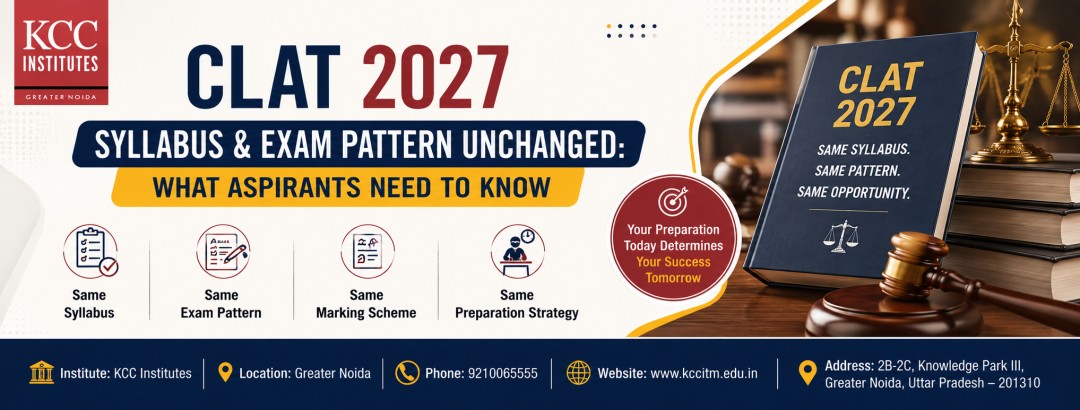
This year, the Consortium of NLUs introduced no new changes to the CLAT 2027 syllabus and exam pattern compared to last year. The announcement was made on July 18, 2026, by the consortium’s governing body.
Previously, the CLAT 2027 exam pattern had 150 questions in total, which was changed in 2025 by reducing it to 120, and this will continue this year. CLAT 2027 subjects include 5 core areas: English Language, Current Affairs including General Knowledge, Legal Reasoning, Logical Reasoning, and Quantitative Techniques.
You must have a thorough understanding of the most recent exam format, section-by-section syllabus, and marking scheme if you're serious about passing CLAT 2027 Exam. You'll find a thorough explanation of the CLAT 2027 section-wise weightage, CLAT 2027 syllabus, and CLAT 2027 exam pattern in this guide, which will help you prepare more effectively, stay clear of uncertainty, and concentrate on what counts most.
Is CLAT 2027 Syllabus Changed?
The CLAT 2027 exam pattern is unchanged, according to official confirmation from the Consortium of National Law Universities (NLUs). The current 120-question, two-hour offline structure will be used for both undergraduate and graduate exams.
Is the CLAT 2027 Exam Pattern Changed?
The consortium of NLUs and NLSIU has confirmed that there will be no changes to the CLAT syllabus 2027 this year. The CLAT 2027 syllabus remains unchanged, with a focus on mandatory UG areas like Constitutional Law, Jurisprudence, and Contract Law.
What is the CLAT 2027 Exam Pattern?
CLAT exam pattern 2027 will test your ability to think, read, and analyse information in addition to your knowledge. The exam primarily assesses your ability to comprehend, reason, and make decisions—all of which are critical for learning law.
The emphasis is largely on your ability to comprehend passages and apply logic; however, some prior knowledge can be helpful, particularly in the Current Affairs and GK area.
The multiple-choice questions (MCQs) of the CLAT 2027 exam are broken up into five main areas, each of which is intended to assess a distinct skill set necessary for a prosperous legal career.
CLAT Exam Pattern 2027 for UG
|
Parameter
|
Key Details
|
|
Exam Mode
|
Offline (Pen & Paper / OMR sheet)
|
|
Duration
|
2 Hours (120 Minutes)
|
|
Total Questions
|
120 Multiple Choice Questions
|
|
Maximum Marks
|
120 Marks
|
|
Medium
|
English
|
|
Marking Scheme
|
+1 mark for every correct answer
|
|
Negative Marking
|
-0.25 marks for every wrong answer
|
CLAT 2027 Section-Wise Weightage
|
Section
|
Percentage
|
Expected Questions
|
|
English Language
|
20%
|
22–26
|
|
Current Affairs & General Knowledge
|
25%
|
28–32
|
|
Legal Reasoning
|
25%
|
28–32
|
|
Logical Reasoning
|
20%
|
22–26
|
|
Quantitative Techniques
|
10%
|
10–14
|
|
Total
|
100%
|
120
|
CLAT 2027 Marking Scheme
120 multiple-choice questions worth one mark each will be included in the two-hour UG-CLAT 2027 exam. Each wrong answer will result in a 0.25-point reduction. Check out the CLAT 2027 marking scheme in the table below:
|
Response
|
Marks
|
|
Correct Answer
|
+ 1 Mark
|
|
Incorrect Answer
|
0.25 Mark
|
|
Unanswered/ Unattempted Question
|
0 Mark
|
What is the CLAT 2027 Syllabus?
Next, comprehending the CLAT 2027 syllabus is just as important for successful preparation. Comprehension, reasoning, and problem-solving abilities are the core CLAT 2027 subjects. As a result, you should concentrate on the following five sections:
CLAT 2027 syllabus subject-wise
|
Subject
|
Description
|
Skills Evaluated
|
|
English Language
|
450-word passages that are appropriate for the 12th grade and can be either fiction or non-fiction.
|
Understanding key concepts, making deductions, summarizing literature, contrasting arguments, and comprehending language in context.
|
|
Current Affairs
|
Journalism, journalistic, or non-fiction writing passages.
|
Knowledge of historical events of ongoing significance, as well as national and international events, the arts, and culture.
|
|
Legal Reasoning
|
Passages that deal with moral and philosophical concerns, public policy challenges, or legal situations.
|
Recognizing and using legal principles in factual situations, as well as comprehending the impact of rule modifications on results.
|
|
Logical Reasoning
|
Brief sections that assess reasoning and argument frameworks.
|
Spotting contradictions, analysing reasoning patterns, recognizing premises and conclusions, and assessing the strength of an argument.
|
|
Quantitative Techniques
|
Questions requiring simple mathematical operations are presented after brief collections of facts or numerical data.
|
Utilizing 10th-standard mathematics, including ratios, proportions, algebra, mensuration, and statistical estimation, to derive and analyse numerical data.
|
CLAT Syllabus 2027 Development: 2026 vs. 2027
The "Inference-based" questions in the English and Logical parts of the CLAT syllabus 2026 have become more complex, even though the fundamental CLAT 2027 syllabus unchanged. Experts forecast for 2027:
-
Increased Focus on Social Issues: Texts from modern history and sociology may be used.
-
Integrated Questions: You may be tested on your logical deduction or legal reasoning in a current affairs passage.
-
Data-Heavy Quant: Be prepared for more intricate caselets with multi-layered percentages.
Common Mistakes to Steer Clear of When Studying the CLAT 2027 Syllabus
When preparing for the CLAT exam, students should steer clear of these three typical mistakes:
-
Ignoring the Newspaper: Monthly digests alone are insufficient to pass the CLAT. Your capacity to assimilate information quickly—a skill that can only be acquired via regular reading—is put to the test.
-
Over-preparing for math: Avoid devoting five hours a day to math. It just weighs ten percent. Adapt your time to the section's grades.
-
Falling for "Rote Learning": The CLAT syllabus 2027 is intended to penalize people who attempt to memorize answers, in contrast to other exams. Pay attention to "Logic" and "Process."
Recommended Study Material
50% of the fight is in selecting the appropriate study materials that keep in line with the CLAT 2027 syllabus and exam pattern. Check out the combination of practice-intensive courses and basic texts below:
-
The 11-module CLAT Complete Set for the 2026 CLAT, AILET, and OLET Exams
-
The two-book CLAT Complete Quantitative Techniques Module Set
-
The two-book CLAT Complete Logical Reasoning Module Set
-
The two-book CLAT Complete English Module Set
Is It Possible to Pass the CLAT in Four Months?
Yes, without a doubt. Four months of concentrated preparation is more than sufficient to secure a top NLU seat if your school-level math and basic English reading skills are satisfactory.
This is a straightforward, useful monthly strategy:
-
Month 1 (Foundation): Become familiar with the course material. Establish a daily reading routine that cannot be compromised. Review the math concepts covered in Class 10 and begin answering topic-specific questions.
-
Month 2 (Building Momentum): Increase the amount of practice you do. Start taking lengthy practice exams (at least one per week) and take the time to examine each error.
-
Month 3 (Refinement): Increase the number of mocks you do each week to two or three. Prioritize section ordering, time management, and reducing poor grades.
-
Month 4 (Final Polish): Revision of Current Affairs notes should be done quickly and using full-length mocks. At this point, avoid beginning any new books or difficult subjects.
Key Takeaway
The methodical approach to getting ready for the CLAT 2027 exam calls for planned study rather than constant study. Understanding the CLAT 2027 syllabus and exam pattern, and eligibility requirements is the foundation. Regular revision, simulated practice, and continuous reading all help to build confidence.
With clarity, adequate preparation, and guidance, it is feasible to pass the CLAT. Success comes from perseverance and wise planning rather than last-minute pressure.
FAQs for CLAT Syllabus and Exam Pattern
Q1. What is the CLAT 2027 exam pattern?
There will be 120 multiple-choice questions (MCQs) in CLAT 2027, broken down into five sections. The exam will last for 2 hours.
Q2. What is the CLAT 2027 marking scheme?
Each correct answer is worth one point, while incorrect responses are worth 0.25 points.
Q3. What topics are covered in the CLAT syllabus 2027?
English comprehension, current affairs and general knowledge, legal reasoning, logical reasoning, and basic mathematics are the core CLAT 2027 subjects. The exam places greater emphasis on analytical abilities and comprehension than memorization.
Q4. Is the CLAT 2027 exam pattern changed?
No significant modifications were introduced in the CLAT 2027 exam pattern. The exam will probably follow the same comprehension-focused, passage-based format as in prior years.
Q5. What does a "good score" on the CLAT mean?
A score of 90 or above out of 120 typically puts you in the top three to five NLUs if the paper is challenging.